Restore the Nipple-Areola Complex After Mastectomy and Breast Reconstruction
Breast reconstruction restores the shape and volume of the breast, but for patients who have lost the nipple and areola during mastectomy, the reconstructed breast may still feel incomplete.
Nipple reconstruction recreates the central projection of the breast and can be followed by areola tattooing to restore color and definition.
For many patients, nipple-areola reconstruction represents the final stage of the breast reconstruction process.
The procedure may be performed using:
- Local breast skin and tissue
- Nipple sharing from the opposite breast in selected patients
- Three-dimensional nipple-areola tattooing
- A combination of surgical reconstruction and tattooing
Dr. Baotram Tran individualizes nipple reconstruction according to the reconstructed breast, available tissue, opposite nipple anatomy, desired projection, symmetry, previous radiation, and patient preferences.
The goal is to create a nipple and areola that restore proportion and visual balance to the reconstructed breast.
What Is Nipple Reconstruction?
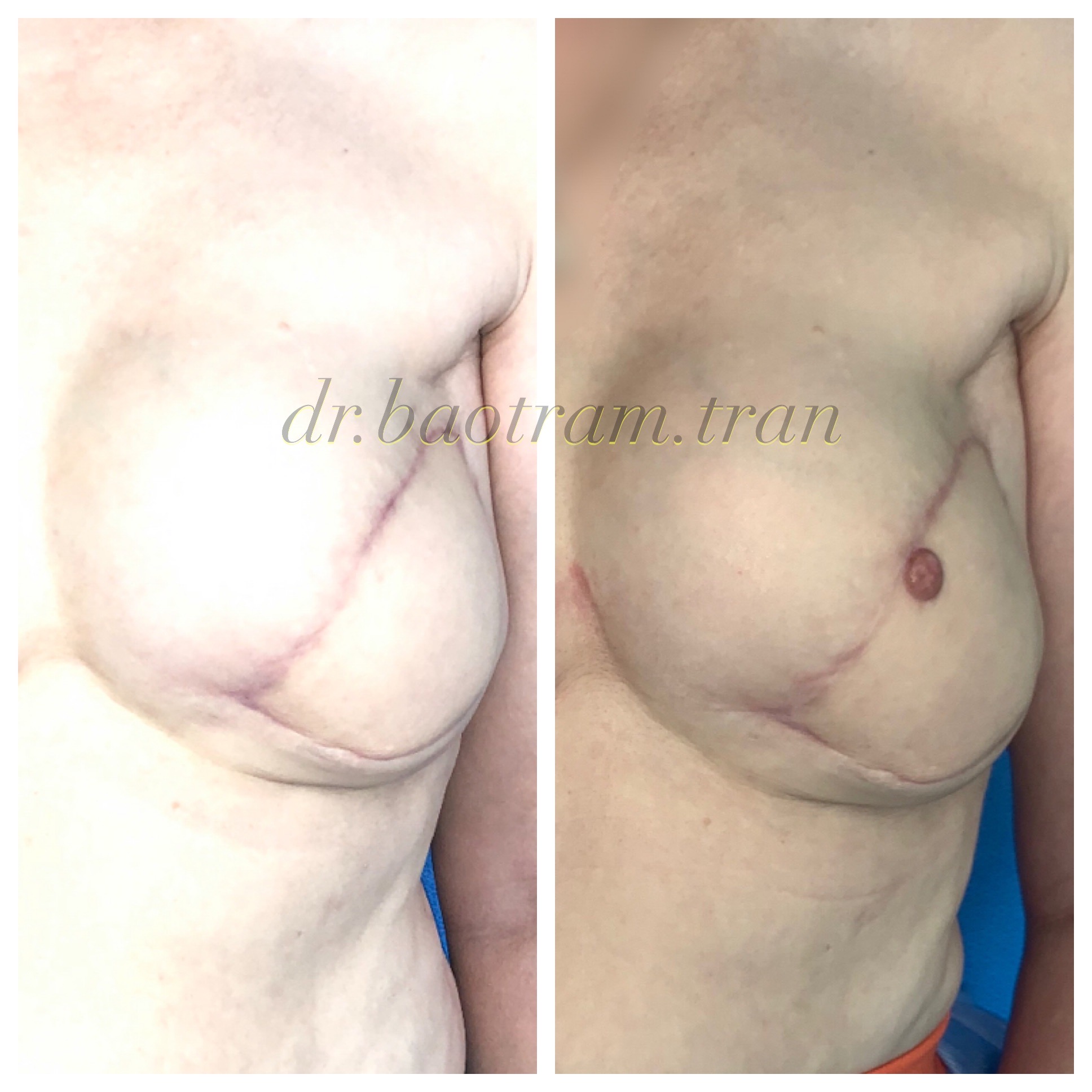
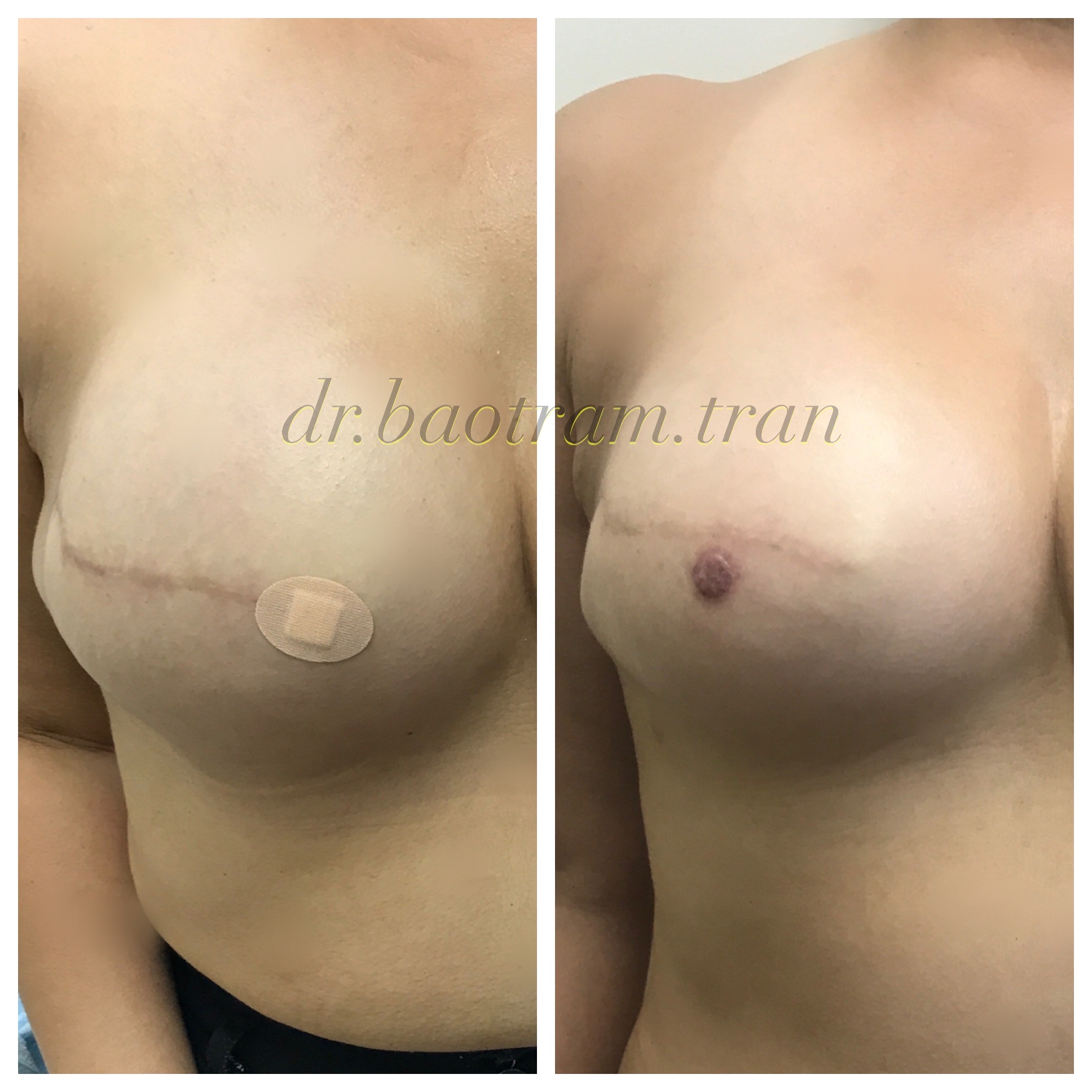
Nipple reconstruction is a procedure designed to recreate a nipple after the original nipple has been removed during mastectomy or lost because of trauma or another condition.
The reconstructed nipple is created using the patient's own tissue whenever possible.
After the nipple has healed, medical tattooing can be used to recreate the areola and add color to the nipple.
Nipple reconstruction may involve:
- Local tissue flap reconstruction
- Nipple-sharing graft from the opposite breast
- Areola tattooing
- Three-dimensional nipple-areola tattooing without surgical projection
- Revision of a previously reconstructed nipple
The appropriate technique depends on the anatomy and the patient's goals.
When Is Nipple Reconstruction Performed?
Nipple reconstruction is generally performed after the breast mound has healed and reached a stable shape.
This may be after:
- Implant-based breast reconstruction
- Tissue-expander reconstruction
- Autologous flap reconstruction
- Revision breast reconstruction
- Radiation therapy when appropriate healing has occurred
Waiting until the reconstructed breast has settled allows the nipple to be positioned according to the final breast shape.
Position is particularly important because the nipple becomes the visual focal point of the reconstructed breast.
Why Is Nipple Position So Important?
The nipple and areola strongly influence how the breast is perceived.
Even when breast volume and shape have been successfully reconstructed, the absence of a nipple may make the breast appear less complete.
During planning, Dr. Tran considers:
- Breast shape
- Breast height
- Breast width
- Position of the opposite nipple
- Breast symmetry
- Scar location
- Desired nipple projection
- Reconstructed breast volume
The nipple should not simply be placed at a predetermined measurement.
Its position should complement the reconstructed breast and, when possible, balance with the opposite breast.
Local Flap Nipple Reconstruction
Creating a Nipple from the Reconstructed Breast Skin
Local flap reconstruction is one of the most common methods of creating a new nipple.
Small areas of skin and tissue on the reconstructed breast are carefully designed and rearranged to form a three-dimensional nipple.
The tissue remains attached to its blood supply while it is shaped into a projecting nipple.
Potential advantages include:
- Uses tissue already present on the reconstructed breast
- Does not require tissue from another body area
- Can usually be performed as a relatively focused procedure
- Can provide natural three-dimensional projection
Many different local flap designs have been described.
The exact technique is selected according to:
- Tissue thickness
- Skin quality
- Previous scars
- Radiation history
- Desired projection
- Breast reconstruction type
Nipple Sharing
Using Tissue from the Opposite Nipple
In selected patients, a portion of the nipple from the opposite breast can be transferred to the reconstructed breast.
This is sometimes called nipple sharing or a composite nipple graft.
This approach may be considered when the natural nipple on the opposite breast is large enough to safely provide tissue.
Potential advantages include similar:
- Nipple color
- Texture
- Shape
- Tissue characteristics
However, nipple sharing is not appropriate for every patient.
The donor nipple must be large enough that removing a portion will not create an unacceptable change in appearance or projection.
Will Nipple Sharing Make the Normal Nipple Smaller?
Yes.
Because tissue is taken from the opposite nipple, the donor nipple will become somewhat smaller.
For patients with a naturally large or prominent nipple, this can sometimes improve symmetry between the two breasts.
The amount of tissue removed is carefully planned to preserve an appropriate donor nipple shape.
Potential changes in:
- Nipple projection
- Sensation
- Appearance
- Breastfeeding potential
should be discussed before surgery.
Surgical Nipple Reconstruction vs. 3D Tattooing
Patients now have more than one option for recreating the appearance of a nipple-areola complex.
Surgical Nipple Reconstruction
Creates true physical nipple projection using tissue.
3D Nipple-Areola Tattooing
Uses pigment and shading techniques to create the visual illusion of nipple projection without creating a surgically projecting nipple.
Some patients choose surgical nipple reconstruction followed by tattooing.
Others prefer tattooing alone.
Neither approach is universally better.
The appropriate choice depends on:
- Desired projection
- Available tissue
- Previous radiation
- Number of procedures desired
- Personal preference
What Is 3D Nipple Tattooing?
Three-dimensional nipple tattooing uses color, shading, and contour techniques to create the appearance of a nipple and areola on a relatively flat surface.
Although no true nipple projection is created, skillful tattooing can produce a realistic three-dimensional visual effect.
3D tattooing may be particularly appealing to patients who:
- Prefer to avoid another surgical procedure
- Do not want nipple projection beneath clothing
- Have thin or irradiated tissues
- Have experienced loss of projection after previous nipple reconstruction
- Want to complete breast reconstruction with minimal additional recovery
Areola Reconstruction
The areola may be reconstructed using tattooing after nipple reconstruction has healed.
Tattooing allows the color, shape, and size of the areola to be customized.
The opposite breast can often be used as a guide when reconstructing one side.
For bilateral reconstruction, areola size and color are selected according to:
- Breast proportions
- Skin tone
- Patient preference
- Desired degree of pigmentation
Medical tattooing has become one of the most commonly used methods of reconstructing the areola.
When Is Nipple-Areola Tattooing Performed?
Tattooing is generally performed after the reconstructed nipple and breast have adequately healed.
This allows:
- Swelling to resolve
- Scar tissue to mature
- Nipple position to stabilize
- Projection to settle
The timing varies according to the type of breast reconstruction and individual healing.
Does Nipple Reconstruction Restore Sensation?
Not necessarily.
A reconstructed nipple is created from skin and soft tissue, but it does not recreate all of the specialized nerves of the original nipple.
Sensation depends on:
- Type of mastectomy
- Breast reconstruction technique
- Existing nerve preservation
- Previous surgery
- Radiation
- Individual healing
The reconstructed nipple may have reduced or absent sensation.
Some surrounding breast skin may gradually regain sensation over time, but normal nipple sensation cannot be guaranteed.
Will the Reconstructed Nipple Stay Projected?
Some loss of nipple projection is expected over time.
Reconstructed tissues naturally contract and settle during healing.
For this reason, the nipple may initially be created slightly more projected than the desired final result.
Published literature has consistently identified loss of projection as one of the most common long-term limitations of surgical nipple reconstruction.
The degree of projection loss varies according to:
- Reconstruction technique
- Tissue quality
- Radiation
- Scar formation
- Breast pressure from clothing
- Individual healing
Can a Reconstructed Nipple Become Flat Again?
Yes.
Partial loss of projection can occur over time.
In some patients, the reconstructed nipple may become substantially flatter.
This does not necessarily mean the reconstruction has failed.
The overall appearance can often still be improved with:
- Tattooing
- Revision nipple reconstruction
- Additional local tissue
- Selected structural support techniques
Treatment depends on the remaining tissue and desired projection.
Nipple Reconstruction After Implant-Based Breast Reconstruction
Patients who have undergone implant-based breast reconstruction may be candidates for nipple reconstruction after the implant and breast shape have stabilized.
Planning considers:
- Implant position
- Breast skin thickness
- Mastectomy scars
- Breast symmetry
- Previous radiation
- Tissue quality
Local tissue can often be rearranged to create nipple projection.
Nipple Reconstruction After Flap Breast Reconstruction
Nipple reconstruction can also be performed after autologous breast reconstruction using the patient's own tissue.
Examples include reconstructed breasts using abdominal or other donor tissue.
These reconstructed breasts may provide relatively substantial soft tissue for local nipple reconstruction.
The final nipple position is planned according to the shape and position of the reconstructed breast.
Nipple Reconstruction After Radiation
Radiation therapy can affect:
- Skin thickness
- Blood supply
- Scar formation
- Tissue flexibility
- Wound healing
Patients with previously irradiated breast tissue may still be candidates for nipple reconstruction, but technique selection and timing require particular attention.
Some patients may prefer 3D tattooing if the tissue is poorly suited to additional surgical manipulation.
Nipple Reconstruction After Bilateral Mastectomy
Patients who have undergone bilateral mastectomy may choose nipple reconstruction on both breasts.
Because there is no opposite natural nipple to use as a reference, nipple position, size, projection, and areola dimensions are designed according to:
- Breast proportions
- Breast shape
- Chest anatomy
- Patient preference
Both nipples are planned together to create the best possible symmetry.
Unilateral Nipple Reconstruction
For patients who have undergone mastectomy on only one side, the natural nipple provides an important reference.
Dr. Tran considers:
- Nipple height
- Nipple projection
- Nipple diameter
- Areola size
- Areola color
- Breast position
Perfect symmetry cannot be guaranteed because a reconstructed nipple and natural nipple are anatomically different.
The goal is visual balance rather than exact duplication.
Can the Opposite Nipple Be Reduced for Better Symmetry?
Yes.
If the natural nipple is significantly larger or more projected than the reconstructed nipple, Nipple Reduction may be considered.
This may be performed alone or as part of nipple-sharing reconstruction.
Treatment should balance:
- Projection
- Nipple size
- Areola size
- Breast symmetry
- Patient preferences
Can Areola Size Be Adjusted?
Yes.
When reconstructing or tattooing the areola, its size can be selected to complement the breast and opposite areola.
Patients with a natural breast may also consider areola adjustment when significant asymmetry is present.
The treatment plan depends on the reconstructed breast and patient preferences.
Revision Nipple Reconstruction
Revision may be considered when a previously reconstructed nipple has:
- Lost projection
- Flattened significantly
- Healed asymmetrically
- Become displaced
- Developed an unfavorable scar
- Become too large or too small
- Developed tissue irregularity
Revision options depend on how much healthy tissue remains.
Potential treatments may include:
- Local tissue rearrangement
- Reduction of an overly prominent reconstructed nipple
- Additional structural support
- Tattoo refinement
- 3D tattooing
Can Nipple Reconstruction Be Performed Without General Anesthesia?
Often, yes.
Isolated nipple reconstruction can frequently be performed under local anesthesia when appropriate.
However, anesthesia depends on:
- Reconstruction technique
- Patient comfort
- Whether additional breast procedures are performed
- Medical considerations
If nipple reconstruction is combined with larger breast revision surgery, a different anesthetic plan may be appropriate.
Your Nipple Reconstruction Consultation
During your consultation, Dr. Baotram Tran will evaluate:
- Type of mastectomy
- Type of breast reconstruction
- Breast shape
- Breast symmetry
- Available breast skin and tissue
- Previous radiation
- Previous nipple reconstruction
- Existing scars
- Opposite nipple size and projection
- Opposite areola size and color
- Desired nipple projection
- Preference for surgery versus tattooing
- Overall reconstructive goals
Your treatment plan may include:
- Local flap nipple reconstruction
- Nipple-sharing graft
- 3D nipple tattooing
- Areola tattooing
- Revision nipple reconstruction
- Nipple Reduction
- Breast Revision Surgery
- Or a combination of approaches
The goal is to choose the simplest approach that creates the appearance and projection you want while respecting the available reconstructed breast tissue.
The Nipple Reconstruction Procedure
Nipple reconstruction is commonly performed as an outpatient procedure.
For an isolated reconstruction, local anesthesia may be appropriate.
The surgical approach depends on the selected technique.
With local flap reconstruction, skin and soft tissue from the reconstructed breast are carefully designed and rearranged to form a projecting nipple.
With nipple sharing, a selected portion of the opposite nipple is harvested and transferred to the reconstructed side.
The reconstructed nipple is then carefully protected during early healing to avoid unnecessary pressure or compression.
Tattooing is generally performed later after adequate healing.
Recovery After Nipple Reconstruction
The First Few Days
Patients may experience:
- Mild swelling
- Bruising
- Tenderness
- Minor drainage
- Temporary firmness
A specialized protective dressing may be used to prevent pressure on the reconstructed nipple.
One to Two Weeks
Swelling and tenderness generally improve.
If removable sutures are used, they may be removed during an early postoperative visit.
Pressure and friction against the nipple should be minimized.
Several Weeks
The reconstructed nipple continues to heal.
Projection may gradually decrease as swelling resolves and the tissues contract.
Several Months
The nipple becomes more stable and scars continue to mature.
Once healing is sufficient, nipple-areola tattooing may be performed when desired.
How Long Does Nipple Reconstruction Last?
Surgical nipple reconstruction is intended to provide long-lasting improvement.
However, reconstructed nipples commonly lose some projection over time.
The final appearance may also change with:
- Scar contraction
- Aging
- Radiation-related tissue changes
- Changes in breast reconstruction
- Implant revision
- Weight changes
Tattoo pigment can also fade over time and may require touch-up treatment.
Nipple Reconstruction Myths and Misconceptions
Myth: Nipple Reconstruction Restores the Original Nipple
No.
The reconstructed nipple is created using available tissue.
It can recreate shape and projection but cannot completely reproduce the original nipple's anatomy, nerves, or function.
Myth: Nipple Reconstruction Restores Normal Sensation
Not necessarily.
Sensation depends on the mastectomy, nerve preservation, reconstruction, and healing.
A reconstructed nipple may have reduced or absent sensation.
Myth: Nipple Reconstruction Must Be Performed Surgically
No.
3D nipple-areola tattooing can create a realistic visual nipple without surgical projection.
Myth: Tattooing and Nipple Reconstruction Are the Same Thing
No.
Surgical reconstruction creates physical projection.
Tattooing creates color and can create the visual illusion of projection.
They are frequently used together.
Myth: Nipple Reconstruction Must Be Done Immediately After Breast Reconstruction
No.
It is usually performed after the reconstructed breast has healed and stabilized.
Myth: A Reconstructed Nipple Will Never Flatten
No.
Loss of projection is common after nipple reconstruction.
Some degree of flattening should be expected over time.
Myth: Both Reconstructed Nipples Will Be Perfectly Identical
No.
Natural and reconstructed breasts are not perfectly symmetrical.
The goal is balanced position, size, and appearance.
Myth: Nipple Sharing Means the Opposite Nipple Is Removed
No.
Only a selected portion of a sufficiently large nipple is used.
The remaining donor nipple is reshaped.
Myth: Tattoo Color Never Fades
No.
Nipple-areola tattoo pigment may fade over time and may require touch-up treatment.
Frequently Asked Questions About Nipple Reconstruction
What Is Nipple Reconstruction?
Nipple reconstruction creates a new nipple after the original nipple has been removed during mastectomy or lost from another condition.
When Is Nipple Reconstruction Performed?
It is generally performed after the reconstructed breast has healed and reached a relatively stable shape.
How Is a New Nipple Created?
A nipple can be reconstructed using local breast skin and tissue or, in selected patients, a portion of the opposite nipple.
What Is a Local Flap Nipple Reconstruction?
A local flap uses skin and tissue from the reconstructed breast and rearranges it to create nipple projection.
What Is Nipple Sharing?
Nipple sharing uses a portion of a sufficiently large nipple from the opposite breast as a graft to recreate the nipple on the reconstructed side.
Will Nipple Sharing Make My Natural Nipple Smaller?
Yes.
A portion of the nipple is removed, so the donor nipple becomes smaller.
This may improve symmetry when the natural nipple is relatively large.
Can You Reconstruct the Areola Too?
Yes.
The areola is most commonly recreated with medical tattooing after the nipple has healed.
What Is 3D Nipple Tattooing?
3D tattooing uses pigment, shading, and color to create the visual appearance of nipple projection without actually creating a projecting nipple.
Do I Need Surgery Before 3D Tattooing?
No.
Some patients choose 3D nipple-areola tattooing alone.
Will the Reconstructed Nipple Have Sensation?
Sensation may be limited or absent.
Normal nipple sensation cannot be guaranteed.
Will the Reconstructed Nipple Stay Projected?
Some loss of projection is expected.
The degree varies among patients and reconstruction techniques.
Can a Flat Reconstructed Nipple Be Revised?
Often, yes.
Revision options depend on available tissue, previous procedures, and desired projection.
Can I Have Nipple Reconstruction After Radiation?
Possibly.
Radiated tissue requires careful evaluation because healing and tissue quality may be affected.
Can Nipple Reconstruction Be Performed Under Local Anesthesia?
Yes.
Many isolated nipple reconstruction procedures can be performed under local anesthesia.
How Long Is Recovery?
Most isolated nipple reconstructions have a relatively limited recovery.
The nipple must be protected from pressure and friction during early healing.
When Can I Have Tattooing?
Tattooing is generally performed after adequate surgical healing and stabilization of the reconstructed nipple.
Will the Tattoo Need Touch-Ups?
Possibly.
Pigment can fade over time and may require additional tattooing.
Can the Opposite Nipple Be Reduced?
Yes.
Nipple Reduction may be considered when the natural nipple is significantly larger than the reconstructed nipple.
What Are the Risks of Nipple Reconstruction?
Potential risks include:
- Bleeding
- Hematoma
- Infection
- Delayed wound healing
- Partial tissue loss
- Complete nipple reconstruction loss
- Unfavorable scarring
- Loss of nipple projection
- Nipple flattening
- Nipple asymmetry
- Nipple malposition
- Under-projection
- Excessive projection
- Pigment mismatch after tattooing
- Tattoo fading
- Changes in sensation
- Need for revision surgery
Previous radiation or compromised breast skin may increase healing concerns.
Individual risks depend on breast reconstruction type, tissue quality, and surgical technique.
Why Choose Dr. Baotram Tran?
Nipple Reconstruction Is a Small Procedure with an Important Visual Role
The nipple and areola occupy a relatively small portion of the breast, but they strongly influence the overall appearance of breast reconstruction.
Position, projection, size, pigmentation, and symmetry all contribute to whether the reconstructed breast looks balanced.
As a double board-certified plastic surgeon, Dr. Baotram Tran approaches nipple reconstruction with attention to:
- Reconstructed breast anatomy
- Nipple position
- Nipple projection
- Breast symmetry
- Available local tissue
- Opposite nipple anatomy
- Previous radiation
- Existing scars
- Local flap reconstruction
- Nipple-sharing techniques in selected patients
- 3D nipple-areola tattooing
- Revision of lost nipple projection
- Donor nipple appearance
- Patient preference regarding physical projection
- Integration with breast revision when appropriate
The goal is not simply to create a nipple. It is to restore the central detail that helps the reconstructed breast look complete and proportionate.
Schedule Your Consultation
If you have completed breast reconstruction following mastectomy and would like to restore the appearance of the nipple and areola, nipple reconstruction may provide the final stage of your breast reconstruction.
During your consultation, Dr. Baotram Tran will evaluate your reconstructed breast, available tissue, breast symmetry, opposite nipple and areola when present, previous radiation, scars, and desired degree of nipple projection.
Your individualized treatment plan may include:
- Local Flap Nipple Reconstruction
- Nipple Sharing
- Areola Tattooing
- 3D Nipple-Areola Tattooing
- Revision Nipple Reconstruction
- Nipple Reduction
- Breast Revision Surgery
- Or a combination of approaches
The appropriate reconstruction depends on your breast anatomy, available tissue, and whether you prefer true nipple projection, tattooed appearance, or both.
Schedule your consultation with Dr. Baotram Tran in Aventura to discuss nipple reconstruction.
REQUEST A CONSULTATION
Please use this form for general information purposes only. DO NOT send personal health information through this form. Specific patient care must be addressed during your appointment.Please complete the following form to request an appointment. Please also note that availability will vary depending on your request. Your appointment will be confirmed by phone by a member of our staff. Thank you!